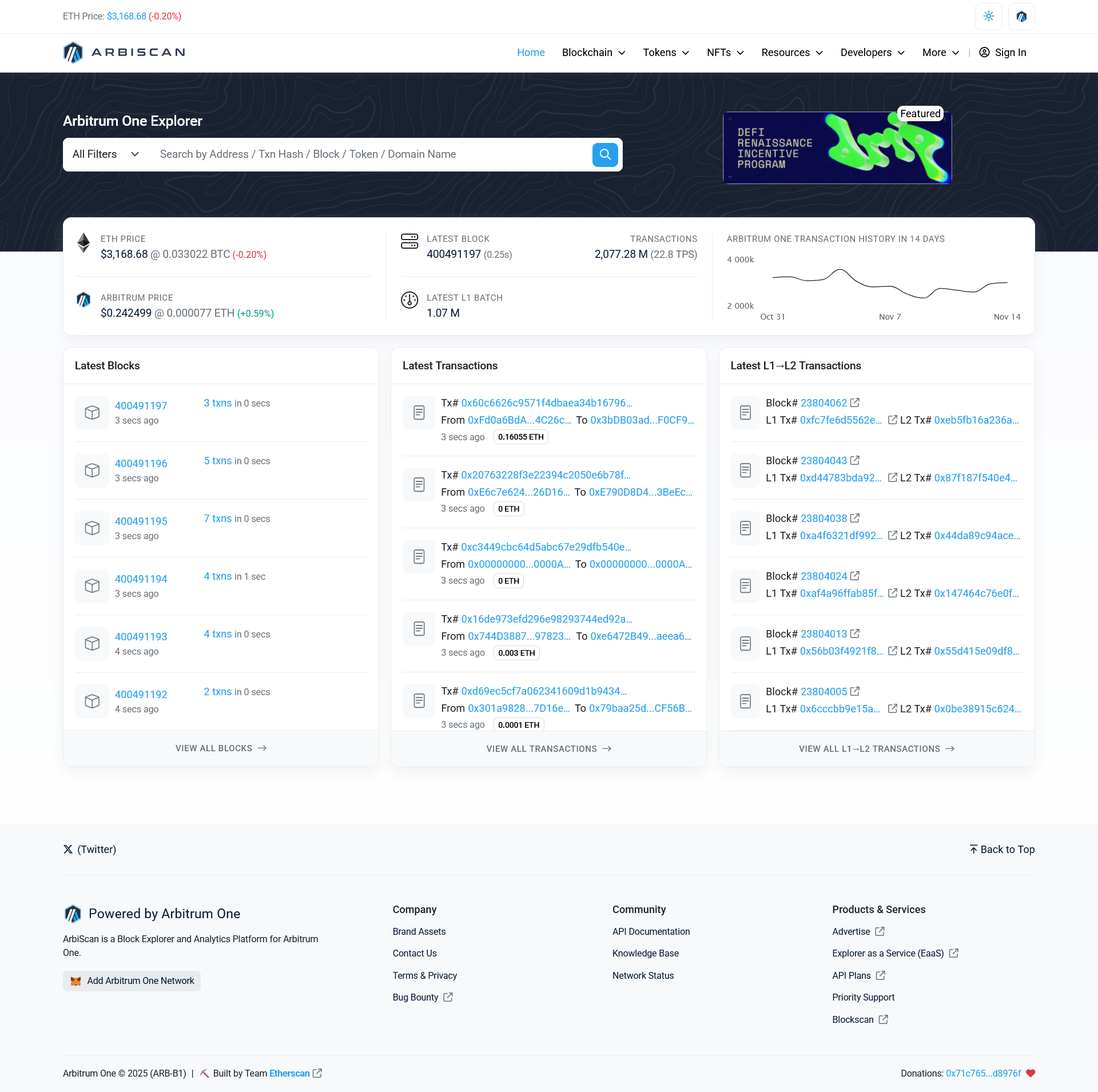
Arbiscan: A Complete Guide to Exploring the Arbitrum Blockchain :-
As blockchain ecosystems continue to grow, transparency and accessibility remain fundamental principles of decentralized networks. For users and developers operating on the Arbitrum network, Arbiscan serves as an essential tool. It provides a window into blockchain activity, enabling anyone to track transactions, monitor smart contracts, analyze tokens, and explore on-chain data in real time.
This article explains what Arbiscan is, how it works, its key features, and why it is important for the Arbitrum ecosystem.
What Is Arbiscan ?
Arbiscan is a blockchain explorer specifically designed for the Arbitrum network, a Layer 2 scaling solution for Ethereum. Built by the same team behind Etherscan, Arbiscan offers a user-friendly interface that allows users to view and verify transactions, addresses, smart contracts, and tokens operating on Arbitrum.
Because Arbitrum processes transactions off the Ethereum mainnet (while still inheriting Ethereum’s security), users need a dedicated explorer to track activity within this Layer 2 environment. Arbiscan fulfills that role.
Understanding Arbitrum ;
Before diving deeper into Arbiscan, it’s important to understand Arbitrum itself.
Arbitrum is a Layer 2 rollup solution that improves Ethereum’s scalability by:
. Reducing transaction costs
. Increasing transaction speed
. Maintaining Ethereum-level security
It achieves this by batching multiple transactions off-chain and posting them to Ethereum as a single transaction. This significantly lowers gas fees and congestion on the main network.
Key Features of Arbiscan
1. Transaction Tracking :-
Users can search for a transaction using its hash (TxID) to view:
. Transaction status (success or failure)
. Gas fees used
. Timestamp
. Sender and receiver addresses
. Token transfers
This is particularly useful when confirming whether a transfer has been completed.
2. Address Lookup :-
By entering a wallet address, users can view:
. Transaction history
. Token balances
. NFT holdings
. Internal transactions
. Interactions with smart contracts
This feature provides transparency and helps users monitor activity associated with any public wallet.
3. Smart Contract Verification :-
Developers can verify their smart contract source code on Arbiscan. Verified contracts:
. Increase transparency
. Build user trust
. Allow public interaction with contract functions
Users can also read and interact directly with contract functions through the “Read Contract” and “Write Contract” tabs.
4. Token Explorer :-
Arbiscan tracks:
. ERC-20 tokens
. ERC-721 NFTs
. ERC-1155 tokens
Users can check:
. Token supply
. Holder distribution
. Transfer history
. Contract details
This is helpful for researching new tokens and verifying legitimacy.
5. Block Explorer :-
Arbiscan allows users to:
. View recently mined blocks
. Analyze block size and transactions
. Check validator/sequencer information
This provides insight into network activity and performance.
6. Analytics and Charts :-
Arbiscan includes analytical tools such as:
. Daily transaction volume
. Gas usage statistics
. Network growth metrics
These insights are valuable for investors, developers, and researchers studying the Arbitrum ecosystem.
Why Arbiscan Is Important :-
1. Transparency
Blockchain technology is built on openness. Arbiscan ensures that all Arbitrum activity is publicly accessible and verifiable.
2. Security
Users can independently confirm transactions instead of relying solely on wallet interfaces or third-party platforms.
3. Developer Support
Arbiscan provides tools and APIs that help developers build decentralized applications (dApps) more efficiently.
4. Research and Due Diligence
Before interacting with a smart contract or token, users can verify contract details and transaction history to reduce risk.
How to Use Arbiscan :-
Using Arbiscan is simple:
1. Visit the Arbiscan website.
2. Enter a wallet address, transaction hash, token name, or contract address into the search bar.
3. Review detailed on-chain data.
No account is required for basic exploration.
Arbiscan vs. Etherscan
Although Arbiscan and Etherscan are built by the same team, they serve different networks:
. Etherscan → Ethereum Mainnet
. Arbiscan → Arbitrum Layer 2
. (Similar explorers exist for other networks as well)
Because Arbitrum transactions are separate from Ethereum mainnet transactions, they require a dedicated explorer.
Limitations of Arbiscan :-
While Arbiscan is powerful, it has some limitations:
. It only displays on-chain data (not off-chain activity).
. It cannot reverse transactions.
. Users must understand basic blockchain concepts to interpret some technical details.
Despite this, it remains one of the most reliable tools in the Arbitrum ecosystem.
Conclusion :-
Arbiscan plays a critical role in maintaining transparency, security, and accessibility within the Arbitrum network. Whether you are a casual crypto user tracking a transaction, an investor researching tokens, or a developer verifying a smart contract, Arbiscan provides the necessary tools to explore Arbitrum’s blockchain activity efficiently.
As Layer 2 adoption continues to grow, explorers like Arbiscan will remain essential infrastructure supporting the decentralized web.